Sunday, November 29, 2009
What are the DemocRats and Bernanke hiding?
Hillbuzz wonders if George Soros is involved in this?
I wouldn't doubt it, based on his affiliations and past history.
Audit would hurt economic prospects: Bernanke
Fri Nov 27, 2009 9:28pm EST
By Mark Felsenthal
WASHINGTON (Reuters) - Federal Reserve Chairman Ben Bernanke said on Friday congressional proposals to audit the Fed and strip it of regulatory powers as part of post-crisis reforms could damage prospects for economic and financial health in the future.
"These measures are very much out of step with the global consensus on the appropriate role of central banks, and they would seriously impair the prospects for economic and financial stability in the United States," Bernanke wrote in a column posted on the Washington Post's website.
The rare newspaper column by a Fed chairman comes shortly before Bernanke testifies before a Senate panel on his renomination to serve a second four-year term at the helm of the central bank and answers a series of steps on Capitol Hill that could diminish the central bank's role.
Lawmakers are angry with the Fed over its emergency bailouts of major financial firms and its failure to prevent the contagion of mortgage delinquencies that crashed the financial system. A proposal to audit the Fed's monetary policy deliberations won a committee vote recently over the objections of House Financial Services Committee Chairman Barney Frank.
Frank's Senate counterpart, Banking Committee Chairman Christopher Dodd, is himself the author of a proposal to consign the Fed solely to making decisions about setting benchmark interest rates.
Bernanke, in his column, conceded the Fed had missed some of the riskiest behavior in the lead up to the crisis. But he said the Fed had helped avoid an even more damaging economic meltdown and has stepped up its policing of the financial system.
"The Fed played a major part in arresting the crisis, and we should be seeking to preserve, not degrade, the institution's ability to foster financial stability and to promote economic recovery without inflation," he said.
Bernanke acknowledged that lawmakers are responding to public anger over the government's response to the turmoil.
"The Federal Reserve, like other regulators around the world, did not do all that it could have to constrain excessive risk-taking in the financial sector in the period leading up to the crisis," he said.
However, the central bank has moved "aggressively" to fix the problems, Bernanke said. The Fed's knowledge of complex financial institutions is invaluable in supervising them, he said.
The Fed's ability to slash interest rates to combat a recession without fueling inflation depends on its political independence he said. Allowing audits of its monetary policy -- as proposed legislation would do -- would increase the perceived influence of Congress on interest rate decisions, he said.
That, in turn "would undermine the confidence the public and the markets have in the Fed to act in the long-term economic interest of the nation," Bernanke wrote.
Frank has said the audit provision is likely to be revisited as legislation winds through both houses of Congress.
Dodd has said his proposal is a starting point for debate.
(Reporting by Mark Felsenthal; Editing Bernard Orr)
© Thomson Reuters 2009 All rights reserved
Saturday, November 28, 2009
Sooner? or Later?
Apocalypse When?
Our enemies are contemplating attacks worse than 9/11.
By Clifford D. May
The Heritage Foundation recently convened a meeting of experts to discuss “Weapons of Mass Destruction and America’s Communities,” the various ways our terrorist enemies might attack us and our allies in the future, and what might be done to stop them. You can imagine what a merry gathering this was.
The most obvious concern: the spread of nuclear weapons. Within the group, there was consensus that if Iran, the world’s leading sponsor of terrorism, is not prevented from acquiring nukes, the result will be a nuclear proliferation “cascade.” Before long, so many countries would have so many nuclear devices that the chances of terrorist groups getting their hands on at least a few would increase exponentially.
A scenario perhaps even more frightening: Terrorists using biological weapons, setting off epidemics of smallpox, Ebola virus, or other hemorrhagic fevers; a crop duster spreading ten pounds of anthrax causing more deaths than in World War II; genetically engineered pathogens — for example, a super-contagious form of HIV. A bio attack would be much easier to carry off than a nuclear attack; biological weapons can be manufactured in hidden laboratories and spread by unarmed and innocent-looking individuals.
We also discussed radiological dispersal devices (RDD), more commonly known as “dirty bombs.” Such weapons are fairly simple to construct: radioactive materials — e.g. radium, radon, thorium — are wrapped around a core of conventional explosives. Though an RDD would not carry the lethality of a nuclear or biological weapon, its psychological and economic impact could be substantial.
How else might terrorists advance toward their goal, succinctly articulated by Iranian president Mahmoud Ahmadinejad as “a world without America”? Adm. Mike McConnell, until February of this year the director of National Intelligence — America’s top spy — recently told Steve Kroft of 60 Minutes that he was increasingly concerned about cyber warfare, the use of computers and the Internet as weapons.
“If I were an attacker and I wanted to do strategic damage to the United States . . . I probably would sack electric power” throughout as much of the country as possible, he said. McConnell worries also about the possibility that a cyber attacker could destroy the electronic processes and records that keep track of money and its movements, thereby setting off an economic collapse.
In the same report, Jim Lewis, director of the Center for Strategic and International Studies, told Kroft: “In 2007 we probably had our electronic Pearl Harbor. It was an espionage Pearl Harbor. Some unknown foreign power, and honestly, we don’t know who it is, broke into the Department of Defense, to the Department of State, the Department of Commerce, probably the Department of Energy, probably NASA.”
Another way to destroy the electric grid as well as everything computerized: an Electromagnetic Pulse Attack. In 2001 the U.S. government established a commission to “assess the threat to the United States” from an EMP attack. The commission reported to Congress that if a nuclear warhead were to be detonated at high altitude over the American mainland the blast would produce a shockwave so powerful that it would “cripple military and civilian communications, power, transportation, water, food, and other infrastructure.” Before long, millions of Americans would, as the Wall Street Journal flatly phrased it, “die of starvation or want of medical care.” The CIA has translated Iranian military journals in which EMP attacks against the U.S. are explicitly discussed.
Among the experts attending this conference, all agreed that the use of such terrorist weapons is a more serious and imminent threat than is “global warming.” Yet no summits are being organized to decide how the U.S. and other targeted nations can best defend themselves.
I would argue also — as I did at the Heritage meeting — that defensive measures alone, while necessary, are not enough. Instead, we must recognize that we are engaged in a great global conflict, one that is no less serious because it is unconventional and asymmetrical.
Outreach, engagement, and exercises in “conflict resolution” are useful when the U.S. has a dispute with Mexico or when the Netherlands disagrees with Luxembourg. But this approach makes no sense when dealing with self-proclaimed jihadis eager to use 21st-century weapons to achieve 7th-century goals.
Iran’s ruling mullahs have been killing Americans for decades — for example, in Beirut, Iraq, and most recently in Afghanistan. They write “Death to America!” on their missiles. It would be both foolhardy and irresponsible to let such extremists acquire nuclear weapons in the hope that somehow, when their capabilities match their intentions, they will suddenly decide they would prefer our respect rather than our destruction.
If we are to prevent our enemies from doing the kind of damage they intend, we must stay on offense. We need to keep our enemies nervous, under pressure, and on the run. We’ll need to go after the bad guys in their training camps, laboratories, and safe houses — wherever those may be. We’ll need to force them to continually look over their shoulders and worry that they may be killed or captured — and being captured should not mean they are rewarded with a global stage to spout their propaganda at American taxpayer expense.
We need to choose: Do we intend to advance or retreat, hunt or be hunted — win or lose? There is no fortress we can construct, no balance of power and terror we can achieve, no gesture or concession that will make us inoffensive to our enemies. When the barbarians are at the gate, you need to do more than lock up — and we haven’t even done that yet.
George Orwell articulated a fundamental rule of national security: “People sleep peaceably in their beds at night only because rough men stand ready to do violence on their behalf.” Most of the West is now led by people who believe that rule may have once applied but no longer. If that doesn’t keep you awake at night, nothing will.
— Clifford D. May, a former New York Times foreign correspondent, is the president of the Foundation for Defense of Democracies, a policy institute focusing on terrorism.
Our enemies are contemplating attacks worse than 9/11.
By Clifford D. May
The Heritage Foundation recently convened a meeting of experts to discuss “Weapons of Mass Destruction and America’s Communities,” the various ways our terrorist enemies might attack us and our allies in the future, and what might be done to stop them. You can imagine what a merry gathering this was.
The most obvious concern: the spread of nuclear weapons. Within the group, there was consensus that if Iran, the world’s leading sponsor of terrorism, is not prevented from acquiring nukes, the result will be a nuclear proliferation “cascade.” Before long, so many countries would have so many nuclear devices that the chances of terrorist groups getting their hands on at least a few would increase exponentially.
A scenario perhaps even more frightening: Terrorists using biological weapons, setting off epidemics of smallpox, Ebola virus, or other hemorrhagic fevers; a crop duster spreading ten pounds of anthrax causing more deaths than in World War II; genetically engineered pathogens — for example, a super-contagious form of HIV. A bio attack would be much easier to carry off than a nuclear attack; biological weapons can be manufactured in hidden laboratories and spread by unarmed and innocent-looking individuals.
We also discussed radiological dispersal devices (RDD), more commonly known as “dirty bombs.” Such weapons are fairly simple to construct: radioactive materials — e.g. radium, radon, thorium — are wrapped around a core of conventional explosives. Though an RDD would not carry the lethality of a nuclear or biological weapon, its psychological and economic impact could be substantial.
How else might terrorists advance toward their goal, succinctly articulated by Iranian president Mahmoud Ahmadinejad as “a world without America”? Adm. Mike McConnell, until February of this year the director of National Intelligence — America’s top spy — recently told Steve Kroft of 60 Minutes that he was increasingly concerned about cyber warfare, the use of computers and the Internet as weapons.
“If I were an attacker and I wanted to do strategic damage to the United States . . . I probably would sack electric power” throughout as much of the country as possible, he said. McConnell worries also about the possibility that a cyber attacker could destroy the electronic processes and records that keep track of money and its movements, thereby setting off an economic collapse.
In the same report, Jim Lewis, director of the Center for Strategic and International Studies, told Kroft: “In 2007 we probably had our electronic Pearl Harbor. It was an espionage Pearl Harbor. Some unknown foreign power, and honestly, we don’t know who it is, broke into the Department of Defense, to the Department of State, the Department of Commerce, probably the Department of Energy, probably NASA.”
Another way to destroy the electric grid as well as everything computerized: an Electromagnetic Pulse Attack. In 2001 the U.S. government established a commission to “assess the threat to the United States” from an EMP attack. The commission reported to Congress that if a nuclear warhead were to be detonated at high altitude over the American mainland the blast would produce a shockwave so powerful that it would “cripple military and civilian communications, power, transportation, water, food, and other infrastructure.” Before long, millions of Americans would, as the Wall Street Journal flatly phrased it, “die of starvation or want of medical care.” The CIA has translated Iranian military journals in which EMP attacks against the U.S. are explicitly discussed.
Among the experts attending this conference, all agreed that the use of such terrorist weapons is a more serious and imminent threat than is “global warming.” Yet no summits are being organized to decide how the U.S. and other targeted nations can best defend themselves.
I would argue also — as I did at the Heritage meeting — that defensive measures alone, while necessary, are not enough. Instead, we must recognize that we are engaged in a great global conflict, one that is no less serious because it is unconventional and asymmetrical.
Outreach, engagement, and exercises in “conflict resolution” are useful when the U.S. has a dispute with Mexico or when the Netherlands disagrees with Luxembourg. But this approach makes no sense when dealing with self-proclaimed jihadis eager to use 21st-century weapons to achieve 7th-century goals.
Iran’s ruling mullahs have been killing Americans for decades — for example, in Beirut, Iraq, and most recently in Afghanistan. They write “Death to America!” on their missiles. It would be both foolhardy and irresponsible to let such extremists acquire nuclear weapons in the hope that somehow, when their capabilities match their intentions, they will suddenly decide they would prefer our respect rather than our destruction.
If we are to prevent our enemies from doing the kind of damage they intend, we must stay on offense. We need to keep our enemies nervous, under pressure, and on the run. We’ll need to go after the bad guys in their training camps, laboratories, and safe houses — wherever those may be. We’ll need to force them to continually look over their shoulders and worry that they may be killed or captured — and being captured should not mean they are rewarded with a global stage to spout their propaganda at American taxpayer expense.
We need to choose: Do we intend to advance or retreat, hunt or be hunted — win or lose? There is no fortress we can construct, no balance of power and terror we can achieve, no gesture or concession that will make us inoffensive to our enemies. When the barbarians are at the gate, you need to do more than lock up — and we haven’t even done that yet.
George Orwell articulated a fundamental rule of national security: “People sleep peaceably in their beds at night only because rough men stand ready to do violence on their behalf.” Most of the West is now led by people who believe that rule may have once applied but no longer. If that doesn’t keep you awake at night, nothing will.
— Clifford D. May, a former New York Times foreign correspondent, is the president of the Foundation for Defense of Democracies, a policy institute focusing on terrorism.
Friday, November 27, 2009
We Ain’t Seen Nothing Yet
The Man-Child-In-Chief has many great decisions in store for us...
If you think things have been rough so far, hang on.
By Victor Davis Hanson
When it comes to the problems facing this country, an old slogan comes to mind: “You Ain’t Seen Nothing Yet.”
High unemployment, the recession, and a terrorist resurgence in Afghanistan are bad enough. But there are a number of problems on the horizon that could dwarf President Obama’s first-year trials.
Why the pessimism? In short, we are doing nothing to prepare for the crises to come.
A global recession has led to low oil prices. Yet in this window of opportunity, America has not decreased its foreign-oil dependence. We are not encouraging domestic exploration. And we are still ambivalent on nuclear power.
But as the world economy recovers, oil will probably surge back over $100 a barrel, increasing our oil-import tab by 25 percent or more. The Obama administration, though, mostly is obsessed with subsidizing relatively small amounts of wind and solar power. It likely won’t be long before angry motorists at the pump are demanding to know why we have not pushed for more development at home of still-plentiful natural-gas and oil fields.
Meanwhile, other economic bad news may be just around the corner. Today, interest rates on short-term Treasury bills still are less than 1 percent. But they, too, will climb as business picks up and worries over American inflation spread.
If we have to pay foreign lenders 5 percent to 7 percent interest on our debt, as in the past, the increased costs will gobble up additional billions from our annual budget. Yet sadly again, we are missing this rare opportunity of low interest to pay off cheaply the trillions that we already owe. Instead, we are borrowing even more!
The War on Terror is also heating up again. Fairly or not, the Fort Hood massacre sent the message that the United States is more worried about appearing politically correct in matters of diversity than about hunting down radical Islamists on its home soil. Those who seek to copy what happened at Fort Hood will be encouraged. And those charged with stopping them will be discouraged and confused.
Such uncertainty was reinforced by the attorney general’s decision to try the architects of 9/11 in federal courts in New York City. At best, the confessed mass-murderer Khalid Sheikh Mohammed will lecture the United States. At worst, one sympathetic juror could find the monster only 99 percent guilty, and therefore the court might fail to convict him of planning the murders of 3,000 innocent people.
After announcing a new strategy of counterinsurgency in March, and appointing Gen. Stanley McChrystal the new supreme commander in Afghanistan, it looks like Obama only now will commit more troops to Afghanistan. That will be a wise decision — but one coming three months after the generals’ request.
We were given an unexpected reprieve through the defeat of al-Qaeda in Iraq. We can now build on that victory by routing the Taliban in the way the Iraq surge stabilized democracy there.
Finally, there is an array of taxes on the horizon — increased federal income-tax rates; promised hikes in health-care surcharge taxes; and even rumors of value-added federal sales taxes. These increases are said to be aimed at the proverbial wealthy. But that could change — given that the top 5 percent of households already provide 60 percent of the nation’s income-tax revenue. And many are already paying 50 percent to 60 percent of their incomes in combined local, state, federal, and payroll taxes.
Just consider. The price of gas will soon likely increase. The cost of servicing our profligate borrowing will, too. One more terrorist attack like at Fort Hood, or nightly sermons from a grandstanding Khalid Sheikh Mohammed, or a new Taliban offensive, and the momentum could shift to radical Islam in its decades-long war against the United States. Next year’s tax hikes will be real and large — and no longer just this year’s idle talk.
As these storm clouds gather, Congress bickers on Saturday nights about borrowing even more money for health-care reform, yet another federal entitlement.
If you think things have been rough so far, hang on, ’cause you ain’t seen nothing yet.
— Victor Davis Hanson is a senior fellow at the Hoover Institution and a recipient of the 2007 National Humanities Medal. © 2009 Tribune Media Services, Inc.
If you think things have been rough so far, hang on.
By Victor Davis Hanson
When it comes to the problems facing this country, an old slogan comes to mind: “You Ain’t Seen Nothing Yet.”
High unemployment, the recession, and a terrorist resurgence in Afghanistan are bad enough. But there are a number of problems on the horizon that could dwarf President Obama’s first-year trials.
Why the pessimism? In short, we are doing nothing to prepare for the crises to come.
A global recession has led to low oil prices. Yet in this window of opportunity, America has not decreased its foreign-oil dependence. We are not encouraging domestic exploration. And we are still ambivalent on nuclear power.
But as the world economy recovers, oil will probably surge back over $100 a barrel, increasing our oil-import tab by 25 percent or more. The Obama administration, though, mostly is obsessed with subsidizing relatively small amounts of wind and solar power. It likely won’t be long before angry motorists at the pump are demanding to know why we have not pushed for more development at home of still-plentiful natural-gas and oil fields.
Meanwhile, other economic bad news may be just around the corner. Today, interest rates on short-term Treasury bills still are less than 1 percent. But they, too, will climb as business picks up and worries over American inflation spread.
If we have to pay foreign lenders 5 percent to 7 percent interest on our debt, as in the past, the increased costs will gobble up additional billions from our annual budget. Yet sadly again, we are missing this rare opportunity of low interest to pay off cheaply the trillions that we already owe. Instead, we are borrowing even more!
The War on Terror is also heating up again. Fairly or not, the Fort Hood massacre sent the message that the United States is more worried about appearing politically correct in matters of diversity than about hunting down radical Islamists on its home soil. Those who seek to copy what happened at Fort Hood will be encouraged. And those charged with stopping them will be discouraged and confused.
Such uncertainty was reinforced by the attorney general’s decision to try the architects of 9/11 in federal courts in New York City. At best, the confessed mass-murderer Khalid Sheikh Mohammed will lecture the United States. At worst, one sympathetic juror could find the monster only 99 percent guilty, and therefore the court might fail to convict him of planning the murders of 3,000 innocent people.
After announcing a new strategy of counterinsurgency in March, and appointing Gen. Stanley McChrystal the new supreme commander in Afghanistan, it looks like Obama only now will commit more troops to Afghanistan. That will be a wise decision — but one coming three months after the generals’ request.
We were given an unexpected reprieve through the defeat of al-Qaeda in Iraq. We can now build on that victory by routing the Taliban in the way the Iraq surge stabilized democracy there.
Finally, there is an array of taxes on the horizon — increased federal income-tax rates; promised hikes in health-care surcharge taxes; and even rumors of value-added federal sales taxes. These increases are said to be aimed at the proverbial wealthy. But that could change — given that the top 5 percent of households already provide 60 percent of the nation’s income-tax revenue. And many are already paying 50 percent to 60 percent of their incomes in combined local, state, federal, and payroll taxes.
Just consider. The price of gas will soon likely increase. The cost of servicing our profligate borrowing will, too. One more terrorist attack like at Fort Hood, or nightly sermons from a grandstanding Khalid Sheikh Mohammed, or a new Taliban offensive, and the momentum could shift to radical Islam in its decades-long war against the United States. Next year’s tax hikes will be real and large — and no longer just this year’s idle talk.
As these storm clouds gather, Congress bickers on Saturday nights about borrowing even more money for health-care reform, yet another federal entitlement.
If you think things have been rough so far, hang on, ’cause you ain’t seen nothing yet.
— Victor Davis Hanson is a senior fellow at the Hoover Institution and a recipient of the 2007 National Humanities Medal. © 2009 Tribune Media Services, Inc.
Tuesday, November 10, 2009
Monday, November 9, 2009
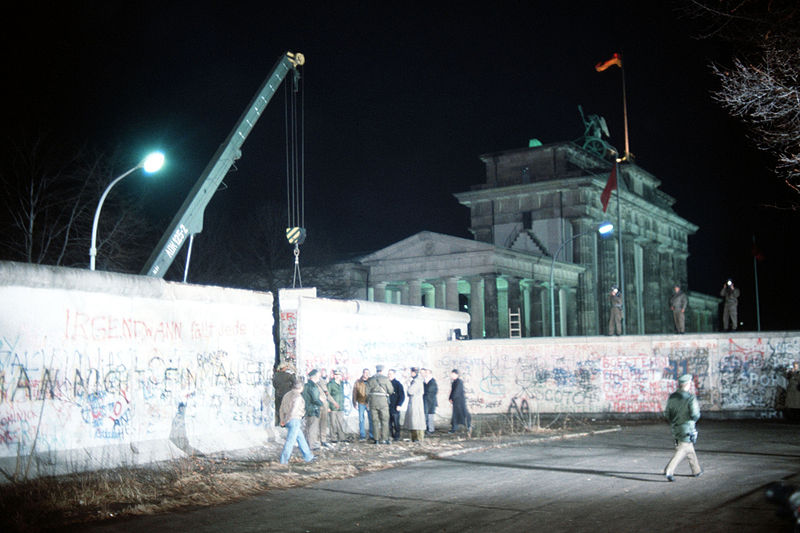
and The Wall came tumbling down...
20 Years ago today, East and West Germany were reunited.
The Wall came down.
It came down because of the efforts of the many Freedom-loving anti-Communists like Ronald Reagan and
Margaret Thatcher.
"We welcome change and openness; for we believe that freedom and security go together, that the advance of human liberty can only strengthen the cause of world peace. There is one sign the Soviets can make that would be unmistakable, that would advance dramatically the cause of freedom and peace. General Secretary Gorbachev, if you seek peace, if you seek prosperity for the Soviet Union and eastern Europe, if you seek liberalization, come here to this gate. Mr. Gorbachev, open this gate. Mr. Gorbachev, tear down this wall!"
It came down because of the efforts of people on both sides of that wall. People that wanted Freedom, instead of repression.
One of the most significant things that's happened in the last 30 years and the President of the United States
can't be bothered to attend. But, of course, he'll be in Denmark next month to collect his Nobel Prize.
Disgusting.
The Wall came down.
It came down because of the efforts of the many Freedom-loving anti-Communists like Ronald Reagan and
Margaret Thatcher.
"We welcome change and openness; for we believe that freedom and security go together, that the advance of human liberty can only strengthen the cause of world peace. There is one sign the Soviets can make that would be unmistakable, that would advance dramatically the cause of freedom and peace. General Secretary Gorbachev, if you seek peace, if you seek prosperity for the Soviet Union and eastern Europe, if you seek liberalization, come here to this gate. Mr. Gorbachev, open this gate. Mr. Gorbachev, tear down this wall!"
It came down because of the efforts of people on both sides of that wall. People that wanted Freedom, instead of repression.
One of the most significant things that's happened in the last 30 years and the President of the United States
can't be bothered to attend. But, of course, he'll be in Denmark next month to collect his Nobel Prize.
Disgusting.
Sunday, November 8, 2009
Moral Cowards
Call this horror by its name: Islamist terror
Last Updated: 12:44 PM, November 7, 2009
Posted: 3:25 AM, November 7, 2009
On Thursday afternoon, a radicalized Muslim US Army officer shouting, "Allahu akbar!" ("God is great!") committed the worst act of terror on American soil since 9/11. And no one wants to call it an act of terror or associate it with Islam.
What cowards we are. Political correctness killed those patriotic Americans at Fort Hood as surely as the Islamist gunman did. And the media treat it like a case of nondenominational shoplifting.
This was a terrorist act. When an extremist plans and executes a murderous plot against our unarmed soldiers to protest our efforts to counter Islamist fanatics, it's an act of terror. Period.
When the terrorist posts anti-American hate speech on the Web; apparently praises suicide bombers and uses his own name; loudly criticizes US policies; argues (as a psychiatrist, no less) with his military patients over the worth of their sacrifices; refuses, in the name of Islam, to be photographed with female colleagues; lists his nationality as "Palestinian" in a Muslim spouse-matching program and parades around central Texas in a fundamentalist playsuit -- well, it only seems fair to call this terrorist an "Islamist terrorist."
But the president won't. Despite his promise to get to all the facts. Because there's no such thing as "Islamist terrorism" in ObamaWorld.
And the Army won't. Because its senior leaders are so sick with political correctness that pandering to America haters is safer than calling terrorism "terrorism."
And the media won't. Because they have more interest in the shooter than in our troops -- despite their crocodile tears.
Maj. Nidal Malik Hasan planned this terrorist attack and executed it in cold blood. The resulting massacre was the first tragedy. The second was that he wasn't killed on the spot.
Hasan survived. Now the rest of us will have to foot his massive medical bills. Activist lawyers will get involved, claiming "harassment" drove him temporarily insane. There'll be no end of trial delays. At best, taxpayer dollars will fund his prison lifestyle for decades to come, since our politically correct Army leadership wouldn't dare pursue or carry out the death penalty.
Maj. Hasan will be a hero to Islamist terrorists abroad and their sympathizers here. While US Muslim organizations decry his acts publicly, Hasan will be praised privately. And he'll have the last laugh.
But Hasan isn't the sole guilty party. The US Army's unforgivable political correctness is also to blame for the casualties at Fort Hood.
Given the myriad warning signs, it's appalling that no action was taken against a man apparently known to praise suicide bombers and openly damn US policy. But no officer in his chain of command, either at Walter Reed Army Medical Center or at Fort Hood, had the guts to take meaningful action against a dysfunctional soldier and an incompetent doctor.
Had Hasan been a Lutheran or a Methodist, he would've been gone with the simoom. But officers fear charges of discrimination when faced with misconduct among protected minorities.
Now 12 soldiers and a security guard lie dead. At least 38 people were wounded, 28 of them seriously. If heads don't roll in this maggot's chain of command, the Army will have shamed itself beyond moral redemption.
There's another important issue, too. How could the Army allow an obviously incompetent and dysfunctional psychiatrist to treat our troubled soldiers returning from war? An Islamist wacko is counseled for arguing with veterans who've been assigned to his care? And he's not removed from duty? What planet does the Army live on?
For the first time since I joined the Army in 1976, I'm ashamed of its dereliction of duty. The chain of command protected a budding terrorist who was waving one red flag after another. Because it was safer for careers than doing something about him.
Get ready for the apologias. We've already heard from the terrorist's family that "he's a good American." In their world, maybe he is.
But when do we, the American public, knock off the PC nonsense?
A disgruntled Muslim soldier murdered his officers way back in 2003, in Kuwait, on the eve of Operation Iraqi Freedom. Recently? An American mullah shoots it out with the feds in Detroit. A Muslim fanatic attacks an Arkansas recruiting station. A Muslim media owner, after playing the peace card, beheads his wife. A Muslim father runs over his daughter because she's becoming too Westernized.
Muslim terrorist wannabes are busted again and again. And we're assured that "Islam's a religion of peace."
I guarantee you that the Obama administration's nonresponse to the Fort Hood attack will mock the memory of our dead.
Going back home.
A neat story.
Unique homecoming to Vietnam for US commander
By BEN STOCKING, Associated (with Terrorists) Press Writer
Saturday, November 7, 2009 at 8:17 p.m.
U.S. Navy Cmdr. Hung Ba Le, center, solutes to Vietnamese officers during a welcome ceremony for his ship USS Lassen and another ship USS Blue Ridge at the Tien Sa Port in Danang, Vietnam, Saturday, Nov. 7, 2009. On the day his side lost the Vietnam War, Hung Ba Le fled his homeland at the age of 5 in a fishing trawler crammed with 400 refugees. Thirty-four years later, he made an unlikely homecoming as the commander of a U.S. Navy destroyer. (AP Photo / Chitose Suzuki)
DANANG, Vietnam — On the day his side lost the Vietnam War, Hung Ba Le fled his homeland at the age of 5 in a fishing trawler crammed with 400 refugees. Thirty-four years later, he made an unlikely homecoming – as the commander of a U.S. Navy destroyer.
Le piloted the USS Lassen on Saturday into Danang, home of China Beach, where U.S. troops frequently headed for R&R during the war, which ended on April 30, 1975, when the southern city of Saigon was taken by communist troops from North Vietnam.
That was the day Le and his family embarked on an uncertain journey in a fishing boat piloted by Le's father, who was a commander in the South Vietnamese navy. They were rescued at sea by the USS Barbour County, taken to a U.S. base in the Philippines, a refugee camp in California and finally to northern Virginia, where they rebuilt their lives.
Le returned on the Lassen, an $800 million, 509-foot destroyer equipped with Tomahawk missiles and a crew of 300. The ship and the USS Blue Ridge, the command vessel for the U.S. Navy's 7th Fleet, are making the latest in a series of goodwill visits to Vietnam, which began in 2003 when the USS Vandergriff paid a port call to Ho Chi Minh City, the former Saigon.
"I thought that one day I would return but I really didn't expect to be returning as the commander of a Navy warship," Le said after stepping ashore Saturday. "It's an incredible personal honor."
"I'm proud to be an American, but I'm also very proud of my Vietnamese heritage," said Le, who spoke a few halting words in Vietnamese.
The ship visits represent the efforts of both the United States and Vietnam to develop their relationship as a balance to Chinese power in the region, without antagonizing Vietnam's massive northern neighbor.
When Le fled in 1975, only four of the eight children in his family made it out of the country. The others stayed in Vietnam until 1983, when the family was reunited.
Le has few memories of his three-day journey on the fishing trawler, which ended just as they were running out of food, water and fuel.
But he has vivid memories of the example set by his father, Thong Ba Le, who is now 69 and has never returned to Vietnam. After the family settled in northern Virginia, he took a job in a supermarket, where he worked his way up from bag boy to manager.
"I always wanted to be like my dad," Le said. "He persevered and overcame many challenges."
Saturday, November 7, 2009
Muslim Male Extremists
A short Quiz:
1 - In 1968 Bobby Kennedy was shot and killed by:
a. Superman
b. Jay Lenno
c. Harry Potter
d. A Muslim male extremist between the age of 17 and 40
2 - In 1972 at the Munich Olympics, Israeli athletes were kidnapped and massacred by:
a. Olga Corbett
b. Sitting Bull
c. Arnold Schwarzenegger
d. Muslim male extremists mostly between the ages of 17 and 40
3 - In 1979, the US embassy in Iran was taken over by:
a. Lost Norwegians
b. Elvis
c. A tour bus full of 80-year-old women
d. Muslim male extremists mostly between the ages of 17 and 40
4 - During the 1980's a number of Americans were kidnapped in Lebanon by:
a. John Dillinger
b. The King of Sweden
c. The Boy Scouts
d. Muslim male extremists mostly between the ages of 17 and 40
5 - In 1983, the US Marine barracks in Beirut was blown up by:
a. A pizza delivery boy
b. Pee Wee Herman
c. Geraldo Rivera
d. Muslim male extremists mostly between the ages of 17 and 40
6 - In 1985 the cruise ship Achille Lauro was hijacked and a 70 year old
American passenger was murdered and thrown overboard in his wheelchair by:
a. The Smurfs
b. Davy Jones
c. The Little Mermaid
d. Muslim male extremists mostly between the ages of 17 and 40
7 - In 1985 TWA flight 847 was hijacked at Athens, and a US Navy diver trying to
rescue passengers was murdered by:
a. Captain Kidd
b. Charles Lindberg
c. Mother Teresa
d. Muslim male extremists mostly between the ages of 17 and 40
8 - In 1988, Pan Am Flight 103 was bombed by:
a. Scooby Doo
b. The Tooth Fairy
c. Butch Cassidy and The Sundance Kid
d. Muslim male extremists mostly between the ages of 17 and 40
9 - In 1993 the World Trade Center was bombed the first time by:
a. Richard Simmons
b. Grandma Moses
c. Michael Jordan
d. M uslim male extremists mostly between the ages of 17 and 40
10 - In 1998, the US embassies in Kenya and Tanzania were bombed by:
a. Mr. Rogers
b. Hillary Clinton, to distract attention from Bill's women problems
c. The World Wrestling Federation
d. Muslim male extremists mostly between the ages of 17 and 40
11 - On 9/11/01, four airliners were hijacked; two were used as missiles to take
out the World Trade Centers and of the remaining two, one crashed into the US Pentagon and the other was diverted and crashed by the passengers. Almost 3,000 people were killed by:
a. Bugs Bunny, Wiley E. Coyote, Daffy Duck and Elmer Fudd
b. The Supreme Court of Florida
c. Mr. Bean
d. Muslim male extremists mostly between the ages of 17 and 40
12 - In 2002 the United States fought a war in Afghanistan against:
a. Enron
b. The Lutheran Church
c. The NFL
d. Muslim male extremists mostly between the ages of 17 and 40
13 - In 2002 reporter Daniel Pearl was kidnapped and murdered by:
a. Tyrone Biggums
b. Captain Kangaroo
c. Billy Graham
d. Muslim male extremists mostly between the ages of 17 and 40
14 - In 2004, Spain railway bombings:
a. Chicanos
b. Chiquita Banana
c. Horacio Equizel
d. Muslim male extremists mostly between the ages of 17 and 40
15 - In 2005, the London Railway bombings were committed by:
a. The Beatles
b. The Luftwaffe
c. Christian youth groups
d. Muslim male extremists mostly between the ages of 17 and 40
16 - In 2009, 13 people were killed and over 30 people injured at Ft. Hood by:
a. George W. Bush
b. Glenn Beck
c. Rush Limbaugh
d. A Muslim male extremist between the age of 17 and 40
Ralph Peters is SPOT-ON!
1 - In 1968 Bobby Kennedy was shot and killed by:
a. Superman
b. Jay Lenno
c. Harry Potter
d. A Muslim male extremist between the age of 17 and 40
2 - In 1972 at the Munich Olympics, Israeli athletes were kidnapped and massacred by:
a. Olga Corbett
b. Sitting Bull
c. Arnold Schwarzenegger
d. Muslim male extremists mostly between the ages of 17 and 40
3 - In 1979, the US embassy in Iran was taken over by:
a. Lost Norwegians
b. Elvis
c. A tour bus full of 80-year-old women
d. Muslim male extremists mostly between the ages of 17 and 40
4 - During the 1980's a number of Americans were kidnapped in Lebanon by:
a. John Dillinger
b. The King of Sweden
c. The Boy Scouts
d. Muslim male extremists mostly between the ages of 17 and 40
5 - In 1983, the US Marine barracks in Beirut was blown up by:
a. A pizza delivery boy
b. Pee Wee Herman
c. Geraldo Rivera
d. Muslim male extremists mostly between the ages of 17 and 40
6 - In 1985 the cruise ship Achille Lauro was hijacked and a 70 year old
American passenger was murdered and thrown overboard in his wheelchair by:
a. The Smurfs
b. Davy Jones
c. The Little Mermaid
d. Muslim male extremists mostly between the ages of 17 and 40
7 - In 1985 TWA flight 847 was hijacked at Athens, and a US Navy diver trying to
rescue passengers was murdered by:
a. Captain Kidd
b. Charles Lindberg
c. Mother Teresa
d. Muslim male extremists mostly between the ages of 17 and 40
8 - In 1988, Pan Am Flight 103 was bombed by:
a. Scooby Doo
b. The Tooth Fairy
c. Butch Cassidy and The Sundance Kid
d. Muslim male extremists mostly between the ages of 17 and 40
9 - In 1993 the World Trade Center was bombed the first time by:
a. Richard Simmons
b. Grandma Moses
c. Michael Jordan
d. M uslim male extremists mostly between the ages of 17 and 40
10 - In 1998, the US embassies in Kenya and Tanzania were bombed by:
a. Mr. Rogers
b. Hillary Clinton, to distract attention from Bill's women problems
c. The World Wrestling Federation
d. Muslim male extremists mostly between the ages of 17 and 40
11 - On 9/11/01, four airliners were hijacked; two were used as missiles to take
out the World Trade Centers and of the remaining two, one crashed into the US Pentagon and the other was diverted and crashed by the passengers. Almost 3,000 people were killed by:
a. Bugs Bunny, Wiley E. Coyote, Daffy Duck and Elmer Fudd
b. The Supreme Court of Florida
c. Mr. Bean
d. Muslim male extremists mostly between the ages of 17 and 40
12 - In 2002 the United States fought a war in Afghanistan against:
a. Enron
b. The Lutheran Church
c. The NFL
d. Muslim male extremists mostly between the ages of 17 and 40
13 - In 2002 reporter Daniel Pearl was kidnapped and murdered by:
a. Tyrone Biggums
b. Captain Kangaroo
c. Billy Graham
d. Muslim male extremists mostly between the ages of 17 and 40
14 - In 2004, Spain railway bombings:
a. Chicanos
b. Chiquita Banana
c. Horacio Equizel
d. Muslim male extremists mostly between the ages of 17 and 40
15 - In 2005, the London Railway bombings were committed by:
a. The Beatles
b. The Luftwaffe
c. Christian youth groups
d. Muslim male extremists mostly between the ages of 17 and 40
16 - In 2009, 13 people were killed and over 30 people injured at Ft. Hood by:
a. George W. Bush
b. Glenn Beck
c. Rush Limbaugh
d. A Muslim male extremist between the age of 17 and 40
Ralph Peters is SPOT-ON!
A Sheepdog Triumphs
On a day when a Muslim Terrorist decides to murder defenseless people, one lone Sheepdog saves the day.
The first 911 calls to the police station on base came in at 1:23 p.m. Officers across the sprawling base sprang into action.Thanks Sergeant!
Kimberly Munley, a 35-year-old police officer, happened to be nearby, waiting for her squad car to get a tune-up, when she heard the commotion. She raced to the scene, according to her boss, Chuck Medley, director of emergency services on base.
As she rounded a corner, she saw Maj. Hasan chasing a wounded soldier through an open courtyard. He looked as though he was trying to "finish off" the wounded soldier, Mr. Medley said.
"He looked extremely focused," said Francisco De La Serna, a 23-year-old medic who had fled the building and was watching the same scene unfold from a hiding spot across the street.
Ms. Munley's first shot missed Maj. Hasan. He spun to face her and began charging, Mr. Medley said.
The time was 1:27 p.m., just four minutes after the initial 911 call.
Authorities haven't said precisely how many shots were fired during the running gun battle between Maj. Hasan and Ms. Munley. But one of her shots hit Mr. Hasan in the torso, knocking him to the ground. With that, officials say, she quite likely prevented more injuries or deaths on the base.
Ms. Munley took two bullets to her legs. Both entered her left thigh, ripped through the flesh and lodged in her right thigh. She also received a minor wound to the right wrist.
Specialist De La Serna, the medic hiding across the street, sprinted to the scene as the shooting stopped and put a tourniquet on Ms. Munley, who was fading in and out of consciousness, he said. Then he moved to Maj. Hasan, who had a gunshot wound through the chest. Mr. De La Serna described the wounded major as calm and quiet, conscious but weak, a handgun at his side.
Ms. Munley underwent surgery Thursday night to halt bleeding and faces at least two more operations to remove the bullets in her thigh. Authorities said her husband, a soldier stationed at Fort Bragg, was on his way. Her Twitter account filled with messages of thanks and admiration from strangers world-wide.
Subscribe to:
Posts (Atom)